Agricultural advice by voice and USSD, for Ethiopian farmers
A personal study, not a commission.
No client and no field testing so far. Everything below is a working hypothesis.
- Status
- Personal study
- Year
- 2026
- Topics
- Ethiopia · Agriculture · Human-Centered Design
Abstract
Ethiopia’s digital transformation is real, but agricultural information still reaches many smallholder farmers poorly: networks are intermittent, phones are basic, literacy varies, and the country speaks many languages. This self-initiated study explores what a digital service for food resilience could look like if it started from those constraints rather than from an app. The answer it proposes is a multi-channel system — voice (IVR), USSD and an offline-first app for extension agents — built around the people farmers already trust. It is a concept, not a deployed service; the last section lists what I will test in the field.
The “tech solution” trap, and reframing the problem
The obvious brief would be: “How can we design an AgriTech mobile app to help Ethiopian farmers increase their yields?”
That premise — technology first, users second — is behind many failed digital initiatives, in the humanitarian sector as in the private one. Desk research on how farmers and pastoralists in Ethiopia access information points to a different starting point: the typical user does not own a recent smartphone, faces frequent network outages, and reading a long text in Amharic on a small screen is a major source of friction.
So the problem is reframed: “How might we help rural communities make informed agricultural decisions, using the channels they already master and the people they already trust?”
This follows the first of the Principles for Digital Development: understand the existing ecosystem, and design with people rather than for them.
Designing for trust
In rural Ethiopia, adopting a new sowing method or acting on a weather warning depends less on an interface than on trust in the messenger. Communication for Development (C4D) — which UNICEF defines as an evidence-based process of dialogue and community engagement for social and behaviour change — puts that relationship at the centre.
The concept is therefore not a tool that leaves the farmer alone with a screen, but one that supports a conversation. It is built around the Development Agent (DA), the government extension worker present in most rural kebeles. Equipped with a richer interface, the agent translates complex climate and market data into advice that fits the community’s immediate needs. The technology reinforces that relationship instead of bypassing it.
The invisible interface: voice and frugal text
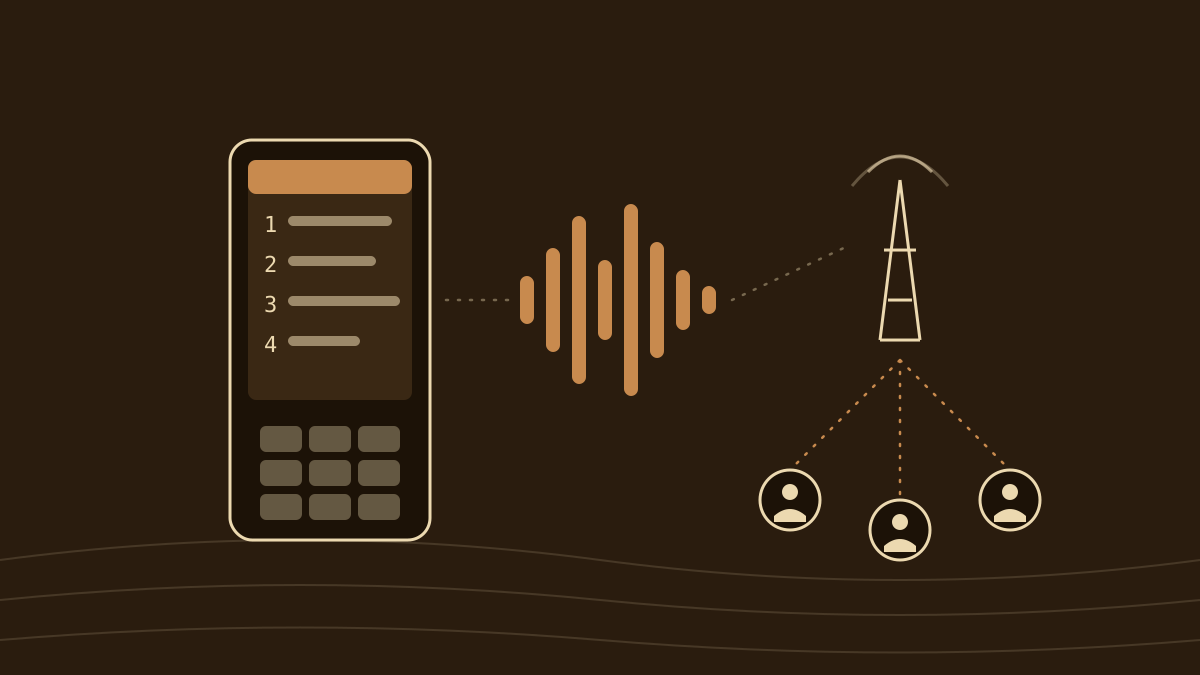
Research on low-literacy users shows that text-only interfaces are often unusable for them, while voice systems make use faster and more comfortable. The information architecture is split into three tiers:
-
Voice first (IVR): an interactive voice service in the farmer’s language (Afaan Oromo, Somali, Amharic). Navigation is auditory, with few choices per step and short prompts to keep cognitive load low.
-
Minimal text (USSD): for a quick question — today’s price of teff at the market — USSD works on any phone, without internet. The design constraint is extreme: a USSD screen holds at most 182 Latin characters, roughly half as many in Ge’ez script, and the session expires within seconds.
-
Offline-first app: for extension agents on entry-level smartphones. It stores data locally and synchronises when the network returns.
Designing from local references
Generic icon libraries assume a Western user. The concept uses local references instead: the grain shown is teff or sorghum, not wheat; objects and scenes come from Ethiopian farms and markets.
Colour is treated as a question to test, not an assumption. Green, yellow and red are Ethiopia’s national colours and carry political meaning; using them as functional signals (red for danger, such as a desert-locust alert) may read differently from what a designer in Brussels expects. That choice belongs in user testing, not in a mood board.
What I will test in the field
This study is desk-based. On my next stays in Ethiopia, I want to test its main hypotheses with farmers, extension agents and cooperative members:
- Which channel do people actually use for information — voice, USSD, SMS, a shared smartphone, the radio?
- Which language, and which script, in each region?
- Who is trusted for agricultural advice: the DA, the cooperative, neighbours, the radio?
- How are phones shared within a household, and who decides what is done with the information?
The case study will be rewritten with what I learn — including where the concept was wrong.
Conclusion
Designing a digital service for rural Ethiopia is an exercise in humility. The innovation is not in adopting the latest trend, but in shaping the information architecture around the cognition, languages and infrastructure of the people who will use it — and checking that with them.
References
- GSMA. (2020). The Mobile Economy Sub-Saharan Africa 2020. GSM Association.
- Medhi Thies, I., Patnaik, S., Brunskill, E., Thies, B., Toyama, K., & Gautama, S. N. N. (2011). Designing Mobile Interfaces for Novice and Low-Literacy Users. ACM Transactions on Computer-Human Interaction (TOCHI), 18(1), 1-28.
- Principles for Digital Development. (n.d.). Understand the Existing Ecosystem. Digital Impact Alliance.
- UNICEF. (2017). Report on Communication for Development (C4D): Global Progress and Country Level Highlights.
- WFP, FAO, IFAD, & UNICEF. (2022). Guide to Formulating Gendered Social Norms Indicators in the Context of Food Security and Nutrition.
Conception and direction: Cédric Luypaerts, 2026.
Working on something similar?
Let’s talk